The Sailing Experience

Early Sailing Ships
The hardest and most dangerous part of emigration was the voyage in the sailing
ship itself.
The
length of the voyage between Hamburg and New York depended on wind conditions
and the weather. An emigrant never knew exactly how long the voyage would take.
The average crossing took 43 days.
Early sailing ships were designed to carry cargo, not passengers, and there was little
effort to adapt them for human comfort.
Most emigrants traveled in steerage accommodations. First and second class
cabins were available, but these could cost anywhere from 3 to 10 times more. Apart from bringing on provisions -
flour, potatoes, oatmeal, tea, some salted fish, and water (often stored in
rancid casks used previously for oil or other containments) - a captain merely
would lay down a temporary deck over the cargo and construct narrow, flimsy
berths that could be dismantled after the voyage.
The prescribed minimum height of the steerage deck was 5 1/2 feet. Sometimes the
flooring was set so far down in the hold that bilge water would seep up through
the planking. Rats scurried about. Ventilation and light came only from the
hatches when they were open. The only lights in the compartment were a few
hanging lamps along the side which could be lit at night.
Passengers were packed tightly, often with no more than a few square feet of
space per
person. There were no toilet facilities and no windows, so
sanitation and ventilation were serious problems. Conditions varied among
vessels, but nearly all emigrants on sailing ships, regardless of class, had to
suffer overcrowding and disorder, seasickness, a foul atmosphere, and poor food. A storm could make things much worse. With the ship
pitching and creaking, decks awash, hatches battened down, people sick
everywhere. It was a miserable experience.
During a storm, emigrants were denied access to the
main deck and the hatches were battened down tightly, leaving little source of
ventilation. The storm could
last for a few days or up to a week or more and the hatches would stay down.
Lights could not be used during the storm because of the danger of fires.
The only way to accommodate all the passengers was to keep half the
steerage deck free for eating and moving about and to stack the other half with
bunks on top of one another in pairs. Along with the crowding came the dirt and
the smell. Some of the odors were those of a normal ship - the bilge and the
perpetually rotting hulk or the lingering odor of old cargo. Others were those
that had settled into the compartment due to lack of ventilation and problems of
previous emigrants. These included the smells of urine and vomit, as well as
rotting refuse that had gotten down into the cracks. Added to that was the smell
of water-soaked bedding or clothing, unwashed passengers, and the current slop
buckets in the compartment.
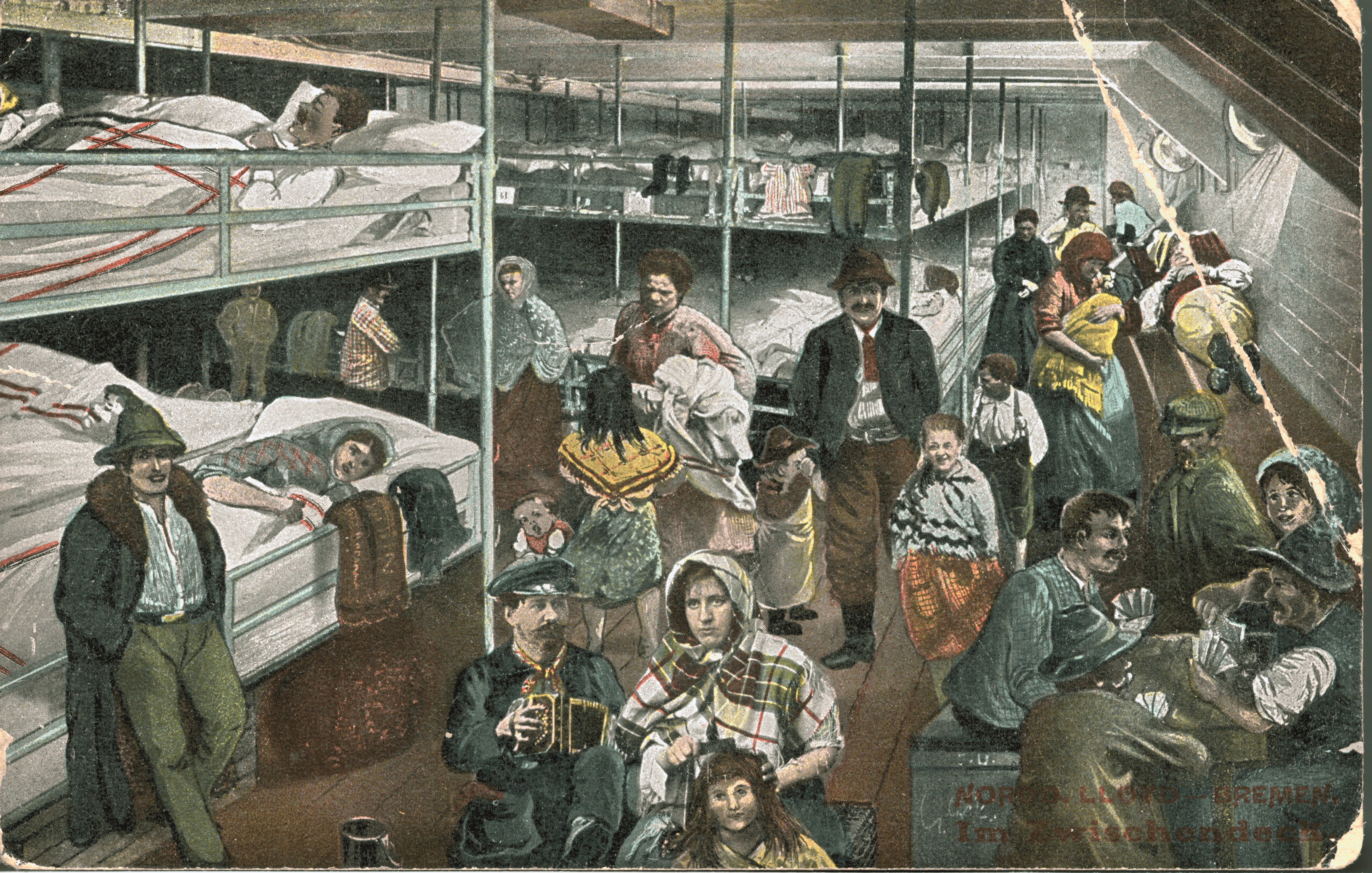
typical steerage compartment
When
there were toilets, they were generally up on deck, beyond the reach of the more
weakened passengers and, in stormy weather, out of the reach of everyone.
There was on average one toilet for every hundred passengers.
The
more usual facility in steerage consisted of a few screened-in-buckets which
might or might not have seats. When storms struck, these often went flying
around the steerage compartment. When seasickness struck, the buckets were often
full or out of reach and many passengers vomited on the floors or in their
berths.
Provisions were measured and doled out carefully to ensure they would last the
required ninety days if necessary. Water was carefully rationed and only a small
amount given to each passenger which had to suffice for drinking, cooking, and
washing of themselves. The diet given passengers was sufficient to keep off
starvation, but not healthy or appetizing. The quality of the provisions taken
on board naturally also suffered from the lengthy voyages of the sailing vessels
and from inadequate food preservation methods. The bread was moldy by the end of
the voyage, the butter and pork fat rancid, the flour full of bugs, and the
water almost undrinkable.
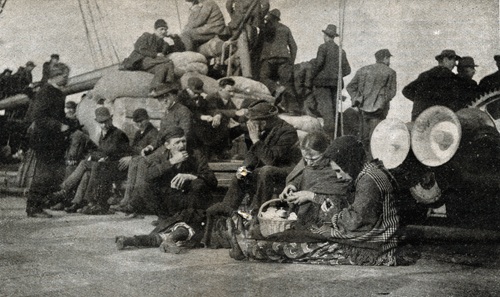
on deck
Cooking
grates were set up on deck for steerage passengers. They had to take turns using
them in order to prepare the family meals. There were always lines of people
waiting to use the grates. Those cooking had to learn new methods. If the ship
lurched, the pot might tip over and the meal would be lost. Boiling liquid could
be spilled which would cause severe burns. During bad weather, the cooking
grates could not be used at all.
Three
diseases in particular were rampant on ships: cholera, typhus, and smallpox.
Cholera, an infection of the stomach and intestines, was a particular problem.
Once cholera struck a ship's passengers, it spread quickly. If there
was no ship's doctor, and there usually wasn't, the captain had the medicine
chest. The medicine chest often contained remedies such as balsam, drops of
various kinds, cream of tartar, peppermint, powdered rhubarb, or pills
advertised on the waterfront as useful for curing a number of ailments. Any of
those treatments might be tried.
Outbreaks
of smallpox were less common but more feared. The disease was often accompanied
by pneumonia, encephalitis, blood poisoning or some other ailment, and the
mortality rate was high.
The worst
killer of all on sailing ships was typhus, a lice borne disease that afflicts
the victim's skin and brain, causing dizziness, headaches, and pain throughout
the body, together with bloodshot eyes, a dark red rash and a dull stare. Typhus
was common in the crowded conditions and was known by the nickname of "ship
fever." It is a wonder that as many passengers survived the voyage as did. Those
that did not were buried at sea.
Early ships were often called "coffin ships" because of the frightful
conditions and the numbers of people who died during the crossings. In 1847
alone,
1,879 immigrants died on the voyage to New York. Eventually government
supervision of sanitation regulations improved conditions.
In 1879 the last emigrant sailing vessel left Hamburg and the steamship became
the sole method of transportation. During the era of the sailing ship
(1836-1880) Hamburg statistics recorded a total of 1,072,404 emigrants leaving
its port. 88% of all of those emigrants chose the USA or Canada as their
destination.
The Steamship Takes Over
On May 29, 1850, the
first Hamburg steamship sailed over the Atlantic Ocean to America. More steamers followed, but the cost of passage was more than that
of the sailing ships. The direct voyage between Hamburg and New York, which had
lasted 43 to 63 days, was shortened to a maximum of 12 to 14 days. In 1856 only
5% of the emigrants landing in New York came by steamship, but by 1870 it was
88%. Increased competition pushed fares down so that steamship crossings finally
cost less than sailings. The Atlantic Ocean crossing to America had changed for the better.
Ancestors who came after 1880 arrived on a steamship and
probably sailed from a German port. Two of the most popular lines were the North German
Lloyd Line out of Bremen/Bremerhaven and the Hamburg-American Line. The North German Lloyd was the largest carrier of immigrant
passengers for many years. In 1892 the line carried almost twice as many
passengers as it's nearest competitor, the Hamburg-American Line.
From 1858-1895 the North German Lloyd steamers alone carried more than 3,000,000
passengers across the Atlantic.
In the 1890's, steerage passage between Bremerhaven and Baltimore cost $30 -
roughly 3 weeks wages for an semi-skilled worker in the U.S., much more for a
Polish farmer! A second-class berth cost $46, and first-class cabins ranged
between $112 and $2000. Every single one of our ancestors traveled via the
steerage compartment.
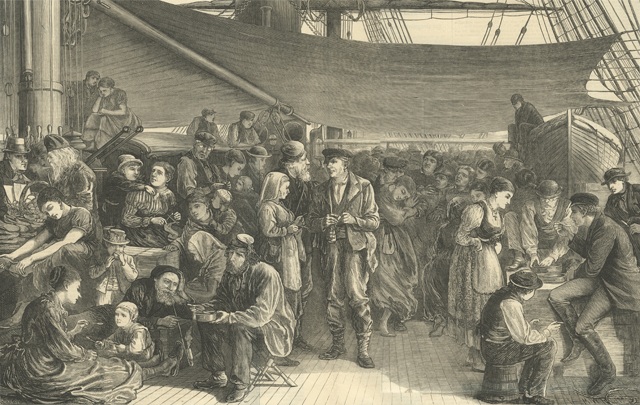
steerage
Despite the improvements with the steamships, there was still no getting
around the filth and stench caused by the cramped quarters. Immigrant ships were
recognized by their smell.
The stench of the unventilated quarters was what
immigrants found hardest to endure.
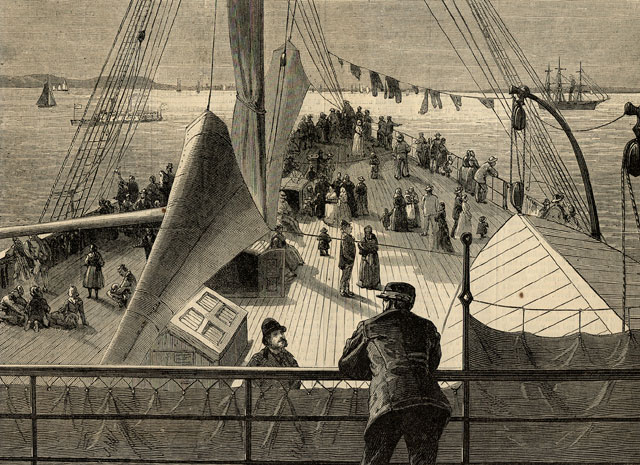
looking for Lady Liberty