Bremen, Germany

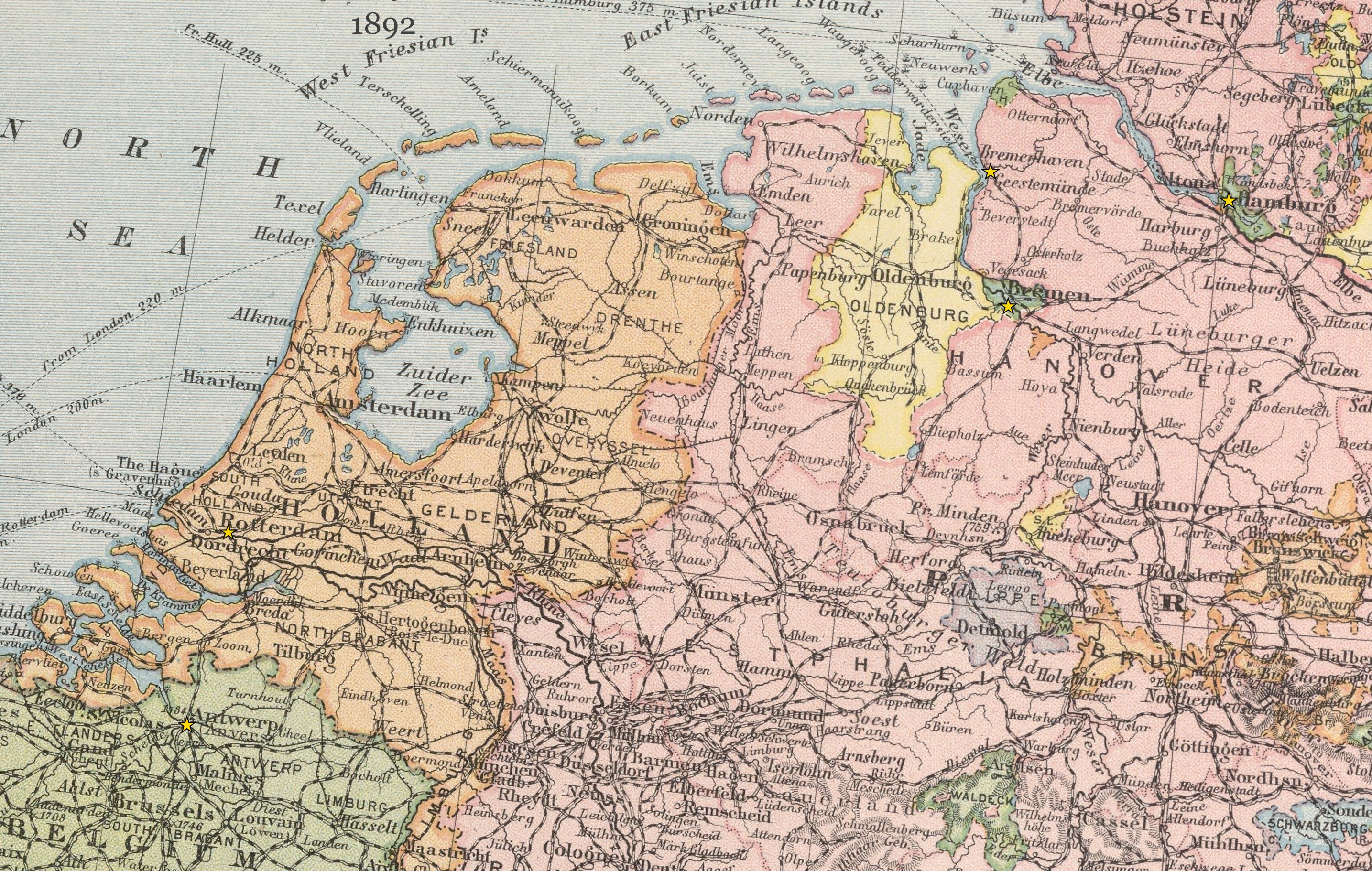
click on map for larger image showing the ports of departure
for northwestern Europe used by our ancestors
The majority of our immigrant ancestors sailed from Bremen, Germany
- or more specifically, Bremerhaven, Germany. The majority of those departing
Bremerhaven sailed to Baltimore, although some did sail to New York City.
Bremen was a booming emigration station in the mid to late 1800s. It was the
headquarters of Nord Deutschen Lloyd Shipping Line (North German Lloyd),
specializing in emigration runs between Bremen-Baltimore and Bremen-New York.

Bremen was founded in the 9th century. Located on the Weser River, about 35
miles inland from the sea,
it developed into one of the major ports of Germany. Because silt began to
reduce the navigability of the river, the city
purchased land near the mouth of the river and founded the city of Bremerhaven
in 1827. By the time of our ancestor's immigrations, all of the larger passenger
vessels were departing from Bremerhaven. Generally, emigrants would arrive overland to
Bremen, where they would remain until day of departure, when they would take a
train or barge to Bremerhaven to board their ship.

Bremerhaven harbor
In the early 1830s, Bremen/Bremerhaven was doing well in the import trade with America. However, when a ship
was ready for the return trip to America, Bremen often did not have
enough export goods and the ship often had to return to America empty. This made the
shipping process very expensive. To combat this problem, Bremen began to lure
part of the emigration traffic away from other European ports such as Le Havre, Antwerp, and Rotterdam. Its efforts proved
immensely successful.
However, the collection of emigrants in Bremen caused some problems for the city. Often
emigrants were stranded there without food and had to go through the city
begging, because they did not have enough money for lodging or passage.
Unscrupulous ship's agents enticed them to Bremen with a promise to ship them to
America and get them a plot of land. Then they took what money the naive emigrants
had without delivering on their promises. There were many other underhanded deals as well. This left the city of
Bremen responsible for providing financial assistance to the penniless emigrants.
In order
to safeguard its emigration business, Bremen passed a decree in 1832 which freed
the city from giving financial assistance to emigrants, while making it
obligatory for ship owners to certify the seaworthiness of their vessels, to keep
passenger lists, and to keep provisions for 90 days on board. This meant that
ship's agents had to deliver what they promised. With this change, Bremen/Bremerhaven became the
preferred port of embarkation for Polish, German, and other European
emigrants. The city of Bremerhaven processed the emigrants at the Emigration
Office, part of which still stands today.
This
policy for protection of emigrants not only made Bremen's America trade more
profitable, but brought considerable benefit to the Bremen economy. The
emigrants, between their arrival and their departure by ship, had to stay in
Bremen lodging houses and feed themselves. Also the emigrant ships had to
purchase substantial quantities of provisions in Bremen. The increased shipping
trade provided business for all trades connected with
the shipping industry.

Boarding a steamer at Nord Deutscher Lloyd Pier, circa 1870
The Nord-Deutscher Lloyd Shipping Line (North German Lloyd) was formed in 1856
in Bremen, and operated between Bremerhaven and New York with its port in Hoboken,
New Jersey. It soon
expanded to other cities.
In
1872, Nord-Deutscher Lloyd advertised two weekly steamers from Bremen to New
York, and a weekly steamer to Baltimore.
Between 1850 and 1880, 38% of the emigrant ships
arriving at Atlantic and Gulf Coast ports of North America were from
Bremen/Bremerhaven. And by the 1870's, the North German Lloyd line had taken
over the entire emigrant trade from Bremen/Bremerhaven. The company would
eventually expand to 93 ocean liners by 1914. It has been calculated that over a two century period, more
than 7 million people emigrated through Bremen and Bremerhaven. While there was
an ordinance requiring shipping companies to make lists of all their
passengers, unfortunately the passenger lists up to 1920 were destroyed - at first
purposely, because they ran out of storage room and then later due to fire. Ship manifests do exist
however, in
the form of passenger arrival lists into the various U.S. ports.
 |
Left: 1891 advertisement for the North German Lloyd Line. Translated
below:
Baltimore and Bremen on the new and tested First Class Mail-Steamships equipped with all the comforts.
|