Overland to destination

After the ocean crossing, which could take as long as 3 weeks, the final leg of the immigrant's journey involved rail travel from the port of arrival to their final destination. The journey had become quite tedious by this point, and no doubt the excitement of finally arriving at destination had become overbearing. This may have seemed like the longest part of the journey. And make no mistake...it was indeed long! From Baltimore, the 853 mile trek to Chicago alone took anywhere from 24 to 36 hours, with New York to Chicago being similar. And of course, for our ancestors, the journey was still not complete. At Chicago, the immigrants would change trains to a regional line serving Menasha or Antigo or wherever their final destination might be.
Immigrants usually bought (or more likely someone bought for them) a package rate which included the entire length of travel from the Old Country to their destination in the New World. But if not, fares from New York to Menasha in 1889 ranged from $23.35 for a day-limited second class ticket to $31.85 for an unlimited duration 1st class ticket; and $25.45 to $33.95 to Menominee, Michigan.
From New York City
If they landed in New York City, they first had to make their way from Castle Garden, at the very southern tip of Manhattan Island, to Grand Central Depot at 42nd Street or cross the Hudson to Hoboken or Jersey City, New Jersey, as no westbound trains reached Castle Garden at that time. The most well-known route to the west was via the New York Central and Hudson River Railroad. This route took the immigrant straight north from New York City along the Hudson River to Albany, NY. From there, the train traveled west to Buffalo, then skirted the south shore of Lake Erie to Toledo and on to Chicago. Train number 3, the "Chicago Express", left New York City at 10:30 a.m. 5 days a week. With 23 stops along the way, the train arrived in Chicago at 8:00 p.m. the following day - a full 34-1/2 hours after leaving New York City! Albany was dinner time (lunch), Syracuse was supper (dinner), Cleveland was breakfast, and Bryan, Ohio was dinner time (lunch) the second day. These stops were usually only 10 minutes in duration.

1885 NY Central and Hudson River Railroad map (click map for larger view)
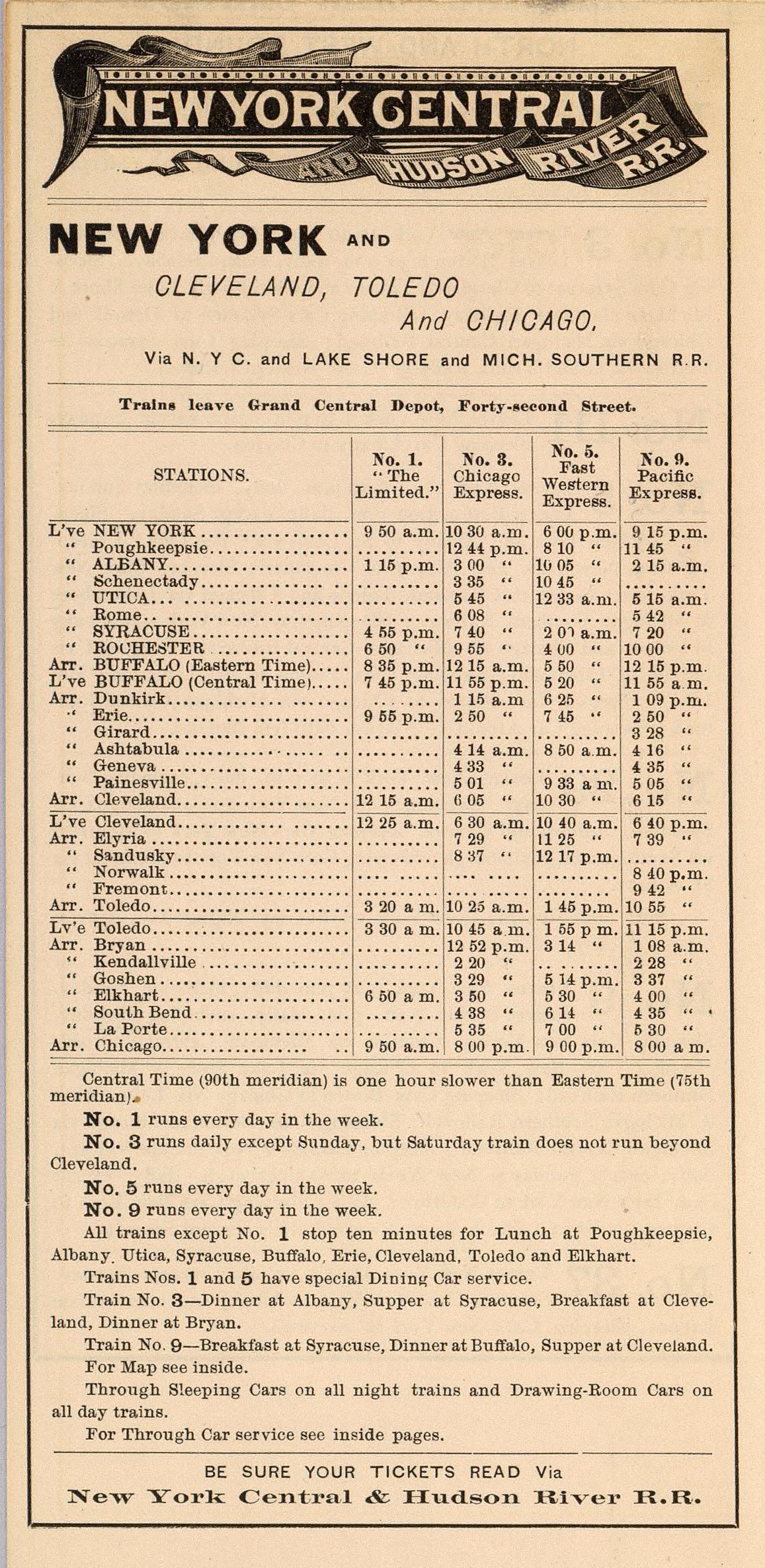
1885 NY Central and Hudson River Railroad Schedule (click image for larger view)
From Baltimore
Those immigrants landing in Baltimore had it much easier, as the Baltimore & Ohio trains were connected directly to the landing piers. Once cleared to enter the United States, it was simply a matter of stepping into the train depot. The B&O took a more southerly route, through Wheeling, WV and Mansfield, OH, but the duration and cost were similar.

1878 map of B&O Railroad routes (click image to enlarge)
From Chicago
Once in Chicago, the immigrant had a few different options for the journey north, including the Chicago & Northwest Railroad, the Chicago, Milwaukee, and St. Paul Railway, or the Wisconsin Central Line. All headed to or through Milwaukee. In Milwaukee, additional rail lines included the the Milwaukee, Lake Shore, and Western Railway, and the Milwaukee and Northern Railway. By the late 1800's, Menasha itself was a large enough transportation hub that some rail lines, including the Wisconsin Central provided through trains, whereby it was not necessary to change trains in Milwaukee. Instead, if Menasha was not the final destination, connecting trains could then be taken from there to Antigo for our Jankowski ancestors, or to Menominee (via Green Bay) for the Brodzinski's.
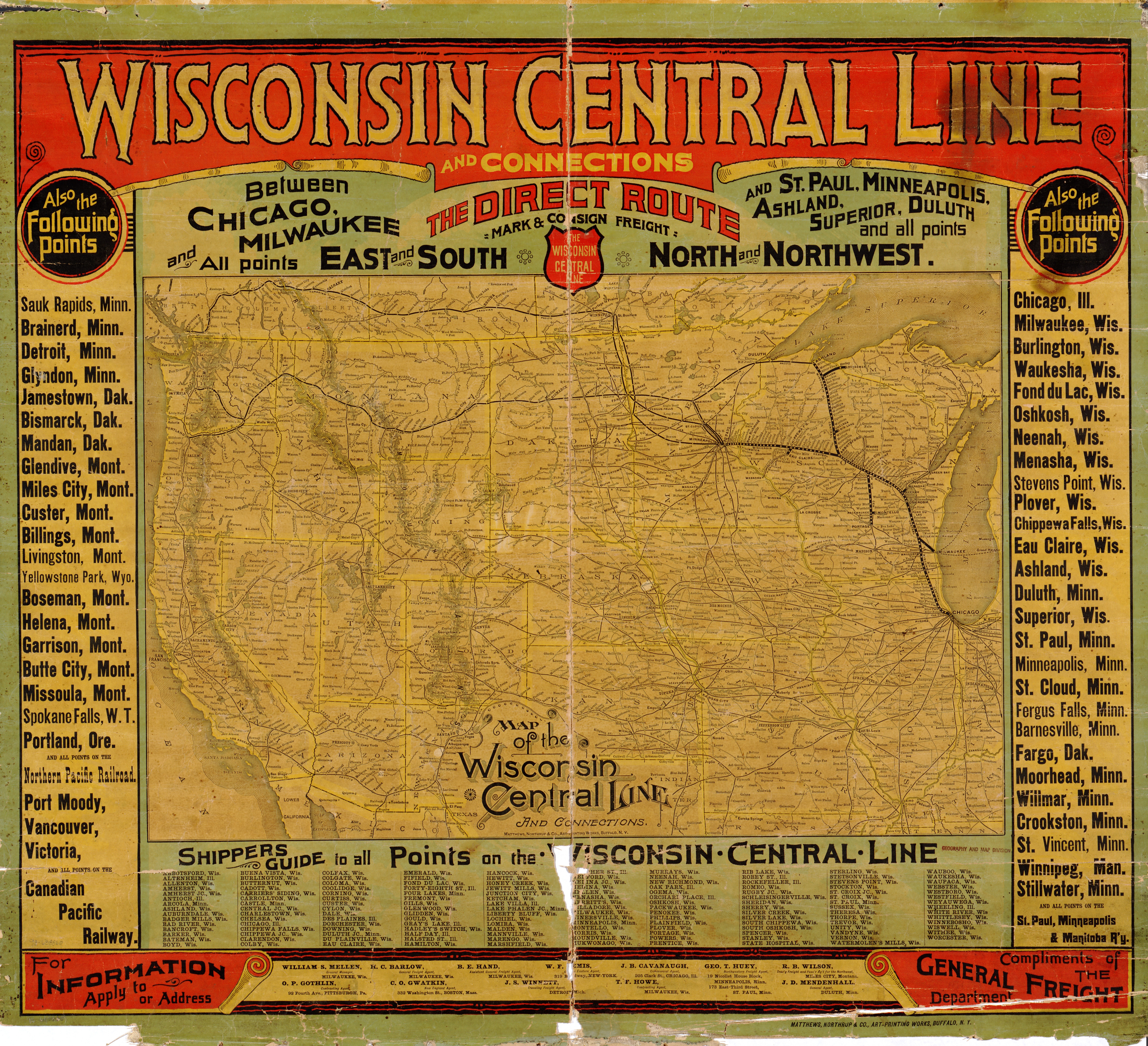
1886 route map of the Wisconsin Central Line (click to enlarge)